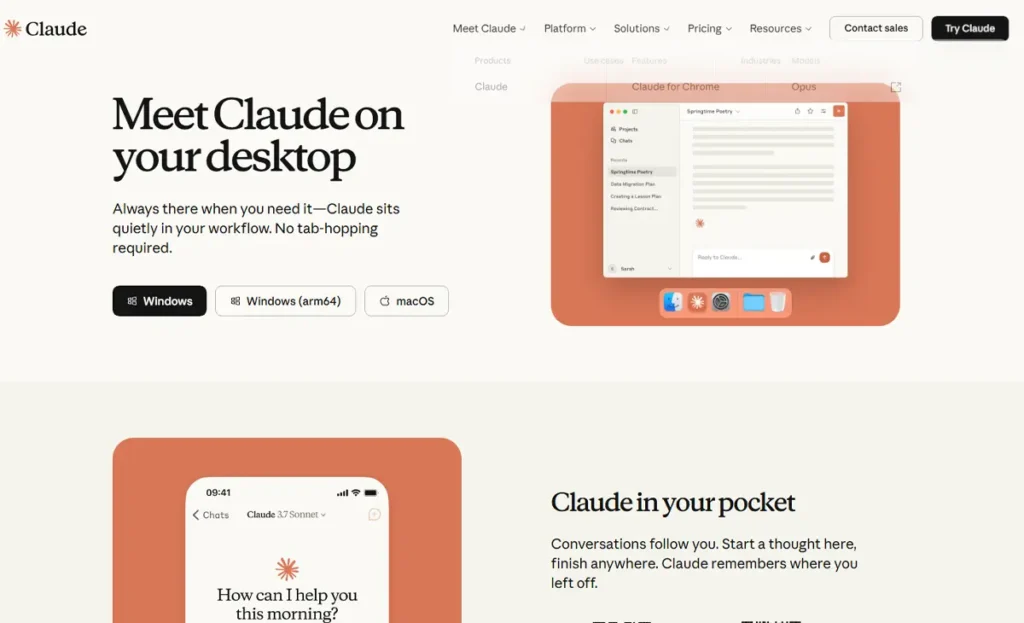
Claude AI, developed by Anthropic, is a family of large language models known as Anthropic’s Claude or simply AI Claude. After testing it extensively over dozens of hours in real workflows from writing long reports to building codebases and automating repetitive tasks I can say it functions more as a thoughtful collaborator than a generic chatbot.
What is Anthropic’s Claude AI Assistants?
Developed by Anthropic, a company founded by former OpenAI executives with a focus on “AI safety,” Claude AIAssistants was built on a foundation called “Constitutional AI.”
The practical result for the user is an AI Claude that feels less like a robotic search engine and more like a highly sophisticated research assistant. It is designed to be helpful, honest, and harmless, which influences everything from its tone to its refusal to generate certain types of content.
Anthropic Models: Opus 4.6, Sonnet 4.6 & Haiku 4.5 Roles
Anthropic offers three main production models in 2026, each optimized for different needs. You select them via the model picker in the Claude AI interface or API.
Claude Opus 4.6 (released February 5, 2026): The flagship model for the most demanding work. It handles complex, multi-step reasoning, long-horizon tasks (up to 14+ hours of continuous planning), deep financial analysis, and full agent teams. With a 1-million-token context window, it processes entire codebases or massive documents in one go. Real value: It delivers production-ready outputs with far less back-and-forth than previous versions ideal when quality on the first try matters.
Claude Sonnet 4.6 (released February 17, 2026): The balanced workhorse and default recommendation for most users. It delivers near-Opus performance on coding (79.6% on SWE-bench Verified), document analysis, automation, and computer use, but at roughly one-fifth the cost of Opus. Real value: Excellent price-to-performance ratio; developers switch to it 59% of the time even when Opus is available because it is fast enough for daily use without sacrificing depth.
Claude Haiku 4.5 (October 2025 version still current): The speed and cost leader for high-volume, simple tasks. It excels at quick classification, summarization, content moderation, and routine queries. Real value: Use it when latency and budget matter more than nuance perfect for pipelines or bulk processing.
Practical tip from testing: Start every project with Sonnet 4.6. Escalate to Opus 4.6 only when you hit reasoning walls or need agent teams. Reserve Haiku for background automation.
Key Features of Claude AI
From hands-on use, these are the features that deliver the most tangible productivity gains:
1M token context window (standard pricing on Opus and Sonnet 4.6) You can upload entire books, long code repositories, or hours of meeting transcripts without truncation.
Claude can control your desktop click buttons, type, take screenshots, and execute real tasks in apps. It feels like having an assistant inside your computer (still maturing but already useful for repetitive workflows).
Agentic tools that turn Claude into an autonomous coder or teammate. It plans, debugs, builds apps, and works directly on your files.
Generates live charts, editable spreadsheets, PowerPoint slides, or functional prototypes you can tweak in real time.
These are not gimmicks they shift Claude AI from “answer machine” to execution partner.
Practical Use Cases (What People Actually Use It For)
After testing across different roles:
Developers & engineers: Building complete apps, debugging large codebases, or generating production-ready code with fewer iterations.
Analysts & researchers: Deep document analysis, financial modeling, meeting summaries, and extracting insights from hundreds of pages.
Business professionals: Automating spreadsheets, creating polished presentations, processing expenses, or turning raw data into actionable reports.
Everyday automation: Turning repetitive tasks (research, data entry, formatting) into one-prompt workflows via Cowork or Computer Use.
What Distinguishes Claude AI
Claude AI stands apart because of Anthropic’s deliberate design choices: Constitutional AI for safety and honesty, a refusal to add ads or manipulative incentives, and a focus on being helpful without hallucinating or over-promising.
In direct comparisons, it produces more natural writing and stronger step-by-step reasoning than many competitors, especially on long-context and coding tasks. It is not the broadest or most multimodal AI (no image/video generation), but it is the one that feels most like a trusted colleague consistent, transparent, and oriented toward getting real work done.
Pros and Cons Claude ai
Advantages
Exceptionally natural and readable writing style.
Superior coding and long-context reasoning in real workflows.
Transparent safety focus reduces risky or misleading outputs.
Ad-free experience and ethical alignment.
Limitations
No native image or video generation use a dedicated tool like Midjourney or ChatGPT for visuals and paste results back into Claude for analysis.
Can be overly cautious and refuse certain prompts rephrase neutrally or break the task into smaller ethical steps.
Usage limits on free/Pro plans during peak times upgrade to Max or use API with prompt caching for heavy work.
Higher per-token cost on Opus ،default to Sonnet 4.6 for 80% of tasks.
The Other Side: Where Are the Weaknesses?
No model is perfect, and Claude AI has its own set of drawbacks that you should be aware of before relying on it completely:
Limited Free Access: The free tier of the Claude 4.6 Sonnet model provides a restricted number of messages per day. This can be quite frustrating if you’re in the middle of a major project and suddenly hit a “usage limit” wall.
Data Freshness: Despite its high intelligence, it can sometimes lack direct, real-time access to certain current events compared to models integrated with massive search engines, such as Grok AI.
Excessive Caution: At times, Anthropic Claude may refuse to answer perfectly standard questions due to its stringent safety protocols. This can sometimes make the model feel “overly conservative” or restrictive when you just need a straightforward answer.
If you are using it for professional work, the paid subscription is a worthy investment. For casual or random use, however, you may find yourself having to wait several hours for your access to reset.
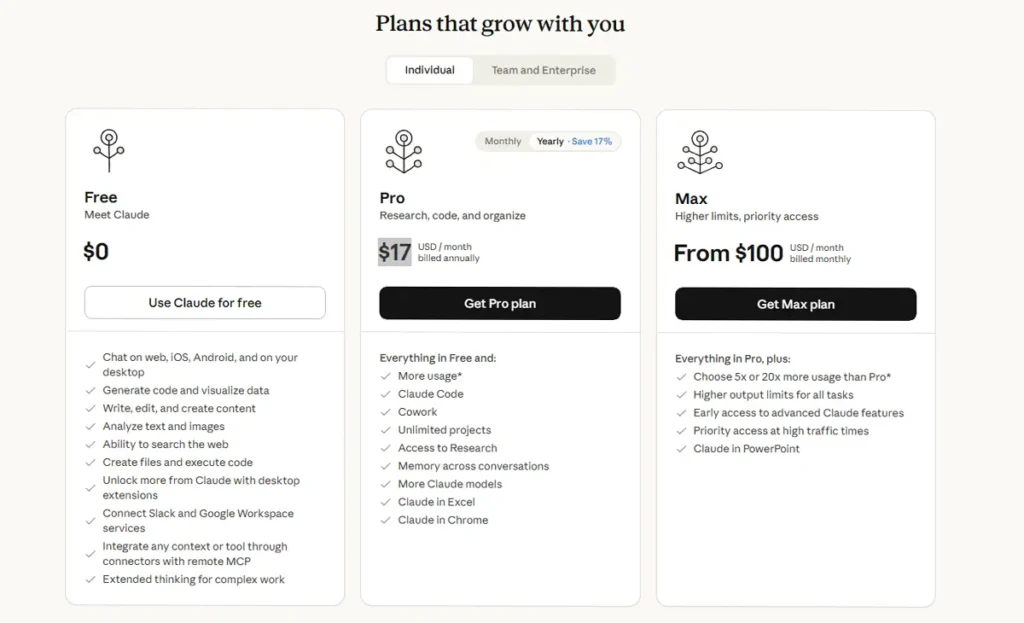
Pricing and Plans claude.ai Web/App + API
Plan
Monthly Price
Annual Price (per month)
Best For
Key Benefits
Usage Limits
Free
$0
$0
Light testing & casual use
Basic access to Claude models
Limited messages (resets daily)
Pro
$17
$17
Everyday productivity
Claude Code, Cowork, unlimited Projects, higher limits, priority access
~5x Free limits
Max 5x
$100
$100
Heavy users & power users
5x Pro usage, full agentic features
Significantly higher
Max 20x
$200
$200
Extreme workloads
20x Pro usage, maximum capacity
Highest session & weekly limits
Team/Enterprise
Starts at $25/seat
~$20–$25/seat
Teams (min. 5 users)
Admin tools, SSO, shared projects, custom options
Higher than Pro (varies by seat)
API Pricing claude ai (per million tokens – March 2026)
Model
Input (per 1M tokens)
Output (per 1M tokens)
Context Window
Best For
Haiku 4.5
$1
$5
200K
Fast, high-volume, simple tasks
Sonnet 4.6
$3
$15
Up to 1M
Coding, reasoning, daily workflows
Opus 4.6
$5
$25
Up to 1M
Complex reasoning, agentic tasks
1M context is now standard (no extra surcharge). Prompt caching and batch API can cut costs dramatically.
Is Claude AI free?
Yes, with limits. Pro ($17/mo) unlocks the features most people need.
How does Claude compare to ChatGPT?
Claude wins on natural writing, coding depth, and long documents. ChatGPT is stronger on image generation and raw versatility. Many professionals now use both.
What is the best Claude model?
Sonnet 4.6 for most daily work; Opus 4.6 when you need maximum intelligence.
Can Claude generate images?
No it analyzes them but cannot create new ones.
Is Claude worth the Pro plan?
Yes if you write, code, or analyze documents daily. The agentic features (Code + Cowork) pay for themselves quickly in time saved.
What makes Anthropic’s Claude different?
Its safety-first philosophy and focus on honest, useful outputs without ads or hype.