

Perplexity AI is a search engine that reads the internet for you, then writes you a sourced answer instead of handing you a list of links.
That’s it. That’s the core product.
You type a question. Perplexity AI searches the web in real time, reads multiple pages, and delivers a direct answer with numbered citations you can click to verify every claim. No ten blue links. No skimming three tabs to piece together the answer yourself.
Where it gets interesting is what it built on top of that foundation: a Deep Research mode that works like a junior analyst running a multi-hour investigation in under five minutes, a multi-model setup that lets you switch between GPT, Claude, and Gemini mid-session, and a full AI-powered browser called Comet. We’ll get to all of that.
But the thing to understand first is what Perplexity isn’t. It’s not a chatbot in the way ChatGPT is. It won’t write your novel, debug your code, or roleplay as a historical figure. That’s not the lane it’s built for. If you come to Perplexity expecting ChatGPT, you’ll be confused. If you come expecting a smarter, more honest version of Google, you’ll find exactly that.
How Perplexity AI Works Differently From Google and ChatGPT
To understand why Perplexity matters, you need to understand the specific problem it’s solving.
The problem with Google gives you links. Finding the actual answer still requires you to open pages, read them, and synthesize the information yourself. For simple questions, that’s fine. For anything complex, you’re doing real research work manually.
The problem with ChatGPT generates answers from its training data — which has a cutoff date and no live web access by default. It sounds confident even when it’s wrong. And when it does search the web, it doesn’t always make clear which claims came from which sources.
What Perplexity does instead It searches the web fresh for every query. The base language models (GPT-4o, Claude, Gemini, or Perplexity’s own Sonar model) provide the reasoning and language capability. The real-time web search provides the current facts. The combination means you get answers that are both well-written and grounded in sources you can actually check.
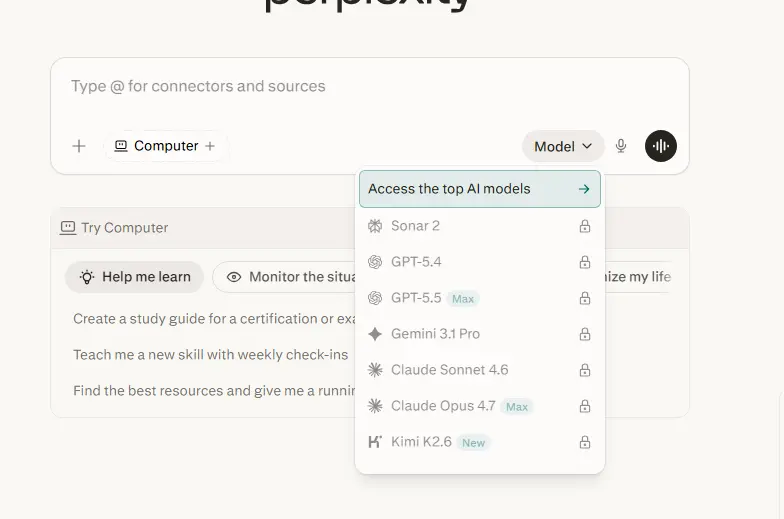
The citation system is the key differentiator. Every factual claim in a Perplexity answer is tagged with a numbered source. Click the number, and you go straight to the original page. This matters enormously for anything where accuracy is non-negotiable medical research, legal questions, financial analysis, competitive intelligence.
Perplexity AI’s Core Features – What’s Actually Useful
Real-Time Web Search With Citations
This is the foundation everything else is built on. Perplexity indexes over 50 billion web pages and updates in real time. When you ask about a news story that broke an hour ago, it finds it. When you ask about a product released last week, it finds that too.
The citations aren’t decorative. They’re inline, numbered, and clickable. When a Perplexity answer cites a claim, you can verify it in one click. This is what separates it from AI tools that generate plausible-sounding text without any accountability for where it came from.
In practice, this makes Perplexity significantly more reliable than ChatGPT for factual questions — not because Perplexity’s underlying models are smarter, but because the system is designed to show its work.
Pro Search vs. Quick Search Perplexity AI
Perplexity has two main search modes for everyday use.
Quick Search handles straightforward questions — definitions, simple facts, recent news. It’s fast and works well for questions that don’t require much reasoning. Free users can run unlimited Quick Searches.
Pro Search kicks in for complex questions. It runs multiple searches, cross-references sources, and applies more reasoning before generating the answer. The difference is noticeable when the question has nuance: “What are the tradeoffs of using PostgreSQL vs. MongoDB for a time-series application?” gets a materially better answer in Pro Search than Quick Search.
Free users get 5 Pro Searches every four hours. Pro subscribers get around 600 per day. That limit is the main practical reason to upgrade for regular users.
Deep Research Mode: What It Does in Practice
Deep Research is Perplexity’s most significant feature — and the one that most distinguishes it from a simple search engine.
When you activate Deep Research on a complex question, Perplexity doesn’t run one search. It runs 20 to 50 targeted searches across hundreds of sources, reads full articles, compares data points, and synthesizes everything into a structured report with an executive summary, key findings, and recommendations. The whole process takes three to ten minutes depending on the complexity.
In benchmark testing, Perplexity’s Deep Research mode scored 21.1% on Humanity’s Last Exam higher than GPT-4, Claude, and DeepSeek on that specific evaluation. On SimpleQA, a factuality benchmark, it scored 93.9%.
Where this is genuinely useful in practice: market research reports that would normally take a junior analyst half a day, literature reviews for academic research, competitive intelligence on a company or product, and policy analysis that requires pulling from multiple government and news sources simultaneously.
As of 2026, Deep Research runs on Claude Opus 4.5 and 4.6 for Pro and Max users, which gives it strong reasoning capability on top of the web retrieval.
Free users get 3 Deep Research queries per day. Pro users get unlimited access.
Spaces: Organizing Research Like a Project Folder
Spaces are Perplexity’s version of a project workspace. You create a Space for a topic — say, “Q2 Competitor Analysis” — and everything related to that project lives there. You can upload documents, save past searches, add notes, and invite collaborators to work from the same knowledge base.
When you query inside a Space, Perplexity draws on both your uploaded documents and live web data simultaneously. If you upload a 100-page internal report and ask Perplexity to cross-reference it against the latest industry news, it does exactly that.
This is the feature that makes Perplexity AI useful for teams rather than just individual researchers. A PR team can maintain a Space with all their brand materials and use it to quickly generate media responses grounded in both their own documents and current news. An investment firm can maintain Spaces for each portfolio company and pull in fresh data on demand.
Pages: Turning Research Into Shareable Reports
Pages converts a Perplexity AI research thread into a clean, formatted, shareable web page. You run your research, click “Convert to Pages,” edit the sections and formatting, add images, and publish to a public link.
The output looks like a properly structured article — not a raw chat log. For anyone who regularly needs to share research findings with people who weren’t in the conversation, Pages eliminates a step. The findings go directly from Perplexity to something you can share without reformatting in a separate tool.
Labs / Create Files & Apps
Labs (also called “Create Files & Apps”) is Perplexity’s project creation layer. It goes beyond answering questions into building outputs: spreadsheets, dashboards, presentations, simple web applications.
The practical use cases: a content manager can generate a SEO-analyzed content calendar with competitive gap data; a financial analyst can build a market snapshot dashboard that pulls live data; a researcher can generate a structured literature review with formatted citations and an exportable table.
Max subscribers get unlimited Labs usage. Pro subscribers get meaningful monthly usage. This feature is still maturing — complex projects can take 30 minutes or more, and outputs sometimes require cleanup — but for structured analytical work, it removes hours of manual formatting.
Comet: Perplexity’s AI Browser
Comet launched in July 2025 as an AI-powered web browser built on Chromium. Initially restricted to the $200/month Max plan, it became a free download for everyone in October 2025 and arrived on iOS in March 2026.
The core idea: instead of navigating to a website and reading it yourself, you navigate there and ask Comet questions about it. It summarizes pages, answers questions about what you’re reading, and can run multi-step tasks — booking a flight, filling out forms, managing email — autonomously.
For research workflows, this is genuinely useful. You can highlight a passage on any page and ask Comet to explain it, find related sources, or cross-reference it against your Spaces.
One honest caveat: a security vulnerability called “CometJacking” was identified by researchers at LayerX, which could potentially exfiltrate personal data. Gartner published a report flagging AI browsers as a category that enterprises should approach carefully for now. For personal research use, the risk is low. For enterprise environments handling sensitive data, that’s worth knowing before rolling it out broadly.
Model Switching: Why This Matters
Most AI tools lock you into one company’s model. Perplexity AI gives Pro subscribers access to GPT-4o, Claude Opus and Sonnet, Gemini 2.5 Pro, Grok, DeepSeek, and Perplexity’s own Sonar models and you can switch between them in the same session.
This is more useful than it sounds. Claude tends to perform better on nuanced analytical writing. GPT-4o is faster for general queries. Grok has fewer content restrictions on certain topics. Being able to use the right model for the right task — without maintaining four separate subscriptions — is one of Perplexity Pro’s strongest practical arguments.
The Max plan also includes “Model Council,” a feature that runs your query through three AI models simultaneously, compares their responses, and synthesizes a higher-confidence answer. It’s particularly useful for investment research, strategic decisions, or any question where you’d want a second and third opinion.
Perplexity AI Pricing Plans — What You Actually Get
Free Plan
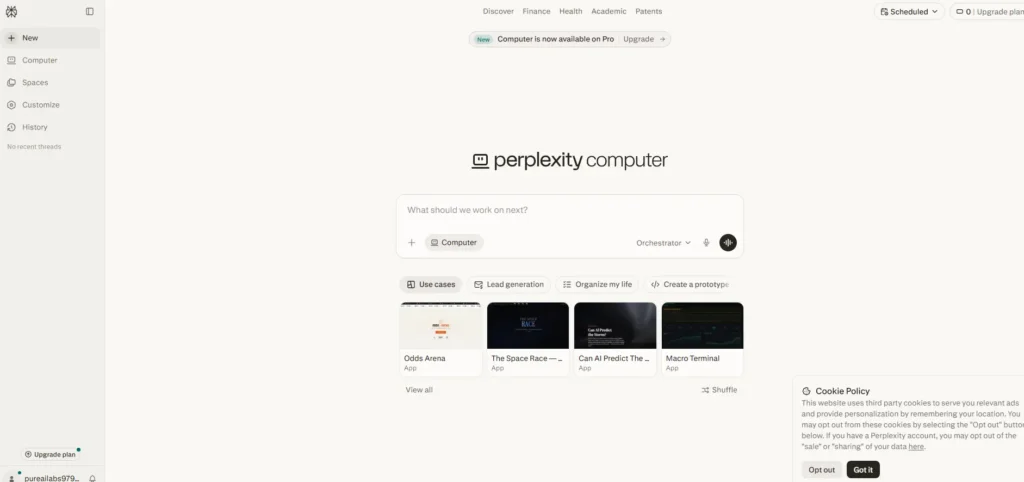
The free plan is usable — and more generous than ChatGPT’s free tier in some respects. You get unlimited Quick Searches, 5 Pro Searches every four hours, 3 Deep Research queries per day, basic file uploads, Voice Mode, and access to Spaces.
The friction shows up fast if you’re doing real work. Five Pro Searches every four hours runs out quickly in a working session. Deep Research at 3 queries per day means you’ll hit the limit before lunch on an intensive project day.
Verdict: Fine for casual use and occasional research. Not sufficient for anyone who plans to use Perplexity as a daily research tool.
Perplexity Pro
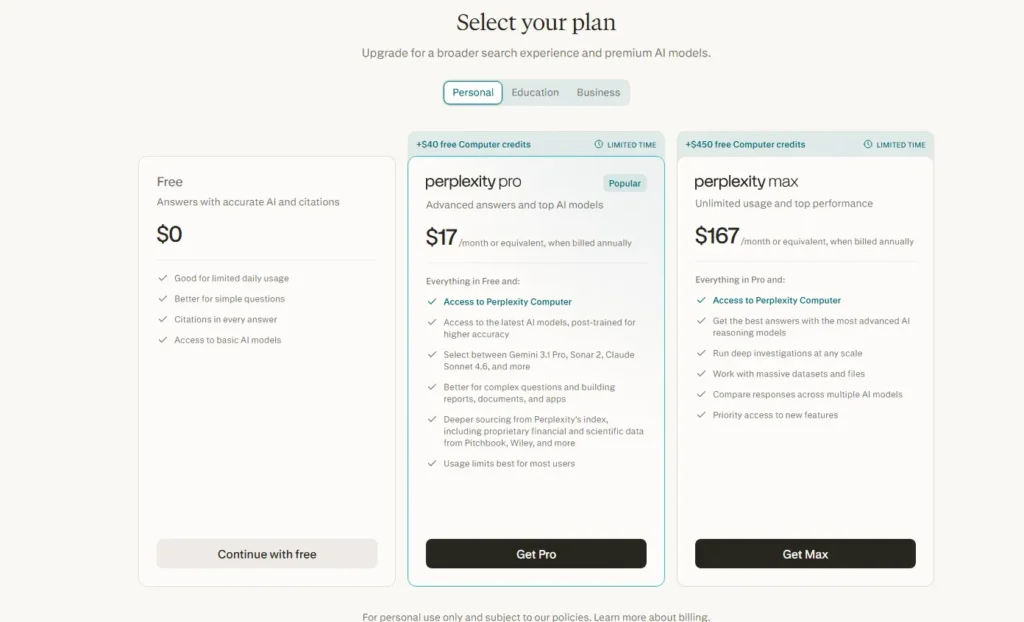
Pro is the plan most serious individual users will land on. It unlocks approximately 600 Pro Searches per day, unlimited Deep Research, unlimited file uploads, access to all premium AI models (GPT-4o, Claude, Gemini, Grok, DeepSeek), image generation via DALL-E and SDXL, and a $5 monthly API credit for developers.
At $20/month, Pro sits at the same price point as ChatGPT Plus and Claude Pro. What you’re trading is generative versatility (ChatGPT and Claude are better at writing and coding) for research depth and citation transparency.
For a journalist, analyst, academic researcher, or anyone who spends significant time finding and verifying information, the trade is worth it. For someone who primarily uses AI for writing, drafting, or coding, ChatGPT or Claude Pro will likely serve better at the same price.
Perplexity Max
Max is built for power users who hit Pro’s limits regularly. It adds unlimited Labs usage, immediate access to new features before they roll out to Pro, the highest-tier model access, Model Council (three-model parallel analysis), Personal Computer (local file editing and local computer use), and priority support.
At $200/month, the argument for Max is consolidation: if you’re currently paying for ChatGPT Plus, Claude Pro, and Perplexity Pro separately, Max bundles much of that capability into one subscription — though it won’t fully replace a dedicated coding environment or a long-form writing tool.
Who should pay $200/month: professionals in research-heavy roles (investment analysts, consultants, investigative journalists) who use Deep Research and Labs daily. For most individuals, Pro at $20/month remains the better value.
Enterprise Pro
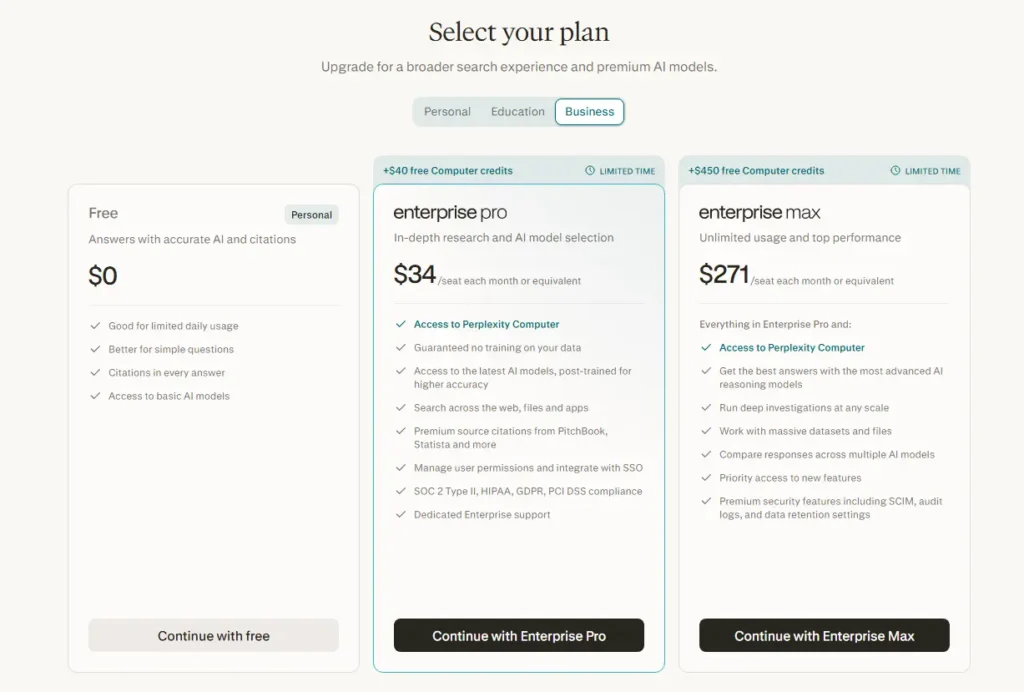
Enterprise Pro gives teams the Pro feature set plus the administrative controls that businesses need: single billing, an admin dashboard, user management, shared Spaces across the organization, SOC 2 compliance, and — critically — a data privacy guarantee that customer data is not used to train Perplexity’s models.
That last point is the most important distinction for enterprise buyers. On the free and Pro plans, your queries may be used for quality improvement. Enterprise Pro contractually removes that. For teams running proprietary research, legal analysis, or competitive intelligence through the platform, that separation matters.
Education Pro
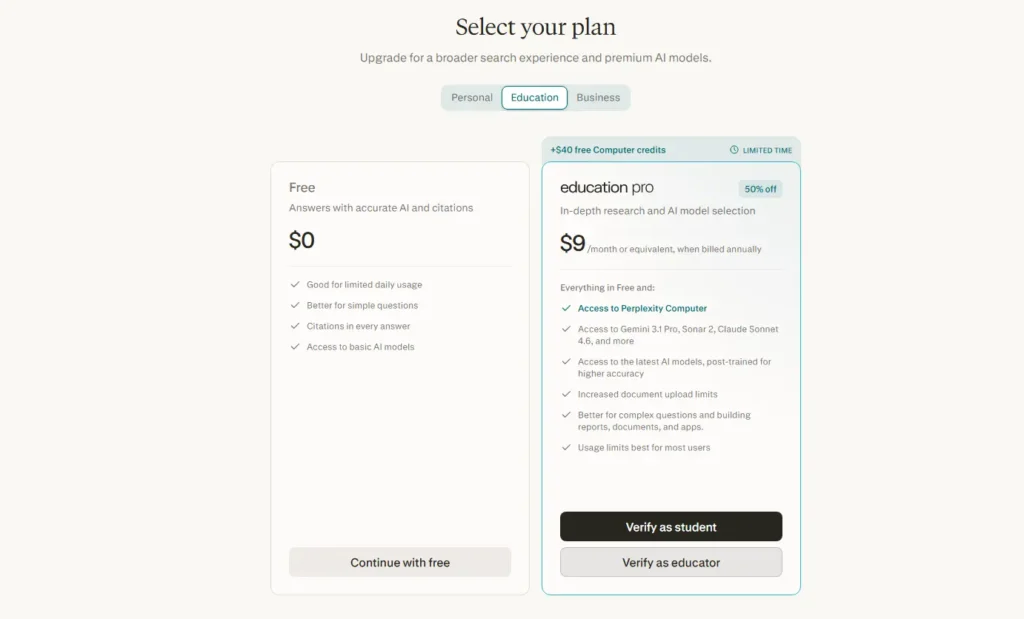
Students and faculty at university-level institutions can access a verified Education Pro plan at $10/month through SheerID verification. Some promotional programs offer the first 12 months free. The plan includes everything in Pro plus extended access to Perplexity AI Academic features.
For students doing literature reviews, thesis research, or any source-heavy academic work, this is straightforwardly good value.
API / Sonar — Pay-as-You-Go Perplexity
The Sonar API gives developers programmatic access to Perplexity’s search infrastructure for building their own applications. Pricing runs from $0.2 to $5 per million tokens depending on the model, with web search tool usage billed at $0.005 per search call. Pro subscribers receive a $5 monthly credit toward API usage.
Real applications built on this: automated fact-checking pipelines, research aggregation tools for newsrooms, literature review systems for academic institutions, and market monitoring dashboards for financial teams.
Perplexity AI vs. ChatGPT A Specific, Honest Comparison
People compare Perplexity and ChatGPT constantly, but the comparison is often framed wrong. They’re not trying to do the same thing. Perplexity AI searches and cites. ChatGPT thinks and creates. Treating them as head-to-head competitors is like comparing a reference library to a writing tutor — both have value, but they solve different problems.
That said, there’s enough overlap that the choice genuinely matters depending on your primary workflow. Here’s where each one wins, based on what independent testing and real user experience actually shows.
Research and Fact-Finding: Perplexity Wins
This is not a close call. When you need current, sourced, verifiable information, Perplexity is the right tool.
In independent testing, Perplexity achieves around 92% factual accuracy on real-time information queries compared to ChatGPT’s 87% even when ChatGPT’s web browsing is enabled. The more meaningful difference isn’t the accuracy gap it’s the transparency.
Perplexity AIshows exactly which source each claim came from, inline, click-through. ChatGPT’s responses read more like a narrative without consistent source attribution.
For regulatory research, scientific literature, competitive intelligence, and anything where you need to be able to defend where your information came from: Perplexity. A regulatory analysis test comparing how both tools handled FDA guidance on AI-based diagnostics found that Perplexity produced a more granular, compliance-oriented response with precise citations to FDA guidance documents, legal analyses, and peer-reviewed sources — while ChatGPT delivered a well-structured but high-level narrative that was more useful for business audiences than compliance teams.
For research, Perplexity also does something ChatGPT’s default interface doesn’t: it suggests follow-up questions and one-click Deep Research prompts after each answer, which actively pulls you deeper into the topic rather than stopping at the first answer.
Writing and Creative Tasks: ChatGPT Wins
This is equally not close. Perplexity is not a writing tool. It can draft summaries and generate text, but it wasn’t built for tone, voice, narrative structure, or creative output.
ChatGPT understands how writing feels. It maintains tone across long documents. It can mimic a writing style, adjust formality, write naturally in the voice of a brand or person, and generate genuinely usable long-form content. Side-by-side tests consistently show ChatGPT producing more natural-sounding drafts and more creative phrasing.
Perplexity, by contrast, tends toward factual neutrality. That’s a strength in research mode and a weakness in writing mode. If you ask it to write a blog post, you get something that reads like a summary of sources, not a piece of writing someone would want to read.
Coding: ChatGPT Wins
Both tools can write and explain code. The gap shows up in extended sessions. ChatGPT maintains full conversation context across a long coding session — it remembers what you built ten messages ago, understands the architecture you’re working in, and can debug across multiple functions. It also has an integrated code sandbox that executes and returns real-time results.
Perplexity AI is useful for looking up code snippets, comparing libraries, or finding documentation — essentially using it as a smarter Stack Overflow. For longer coding sessions, debugging, or building something from scratch, ChatGPT (or Claude, or a dedicated coding environment) handles the work better.
Real-Time News and Current Events: Perplexity Wins
ChatGPT’s free plan has a knowledge cutoff. Even with web browsing enabled on paid plans, it loads pages one at a time and doesn’t provide consistent inline citations. Perplexity indexes the web continuously and treats real-time information as the foundation of every response.
For anything that happened in the last 24 hours — a policy change, a market move, breaking news Perplexity AI finds and synthesizes it faster, more reliably, and with clearer sourcing than ChatGPT.
Who Should Use the Perplexity Tool?
Researchers and Students
Perplexity AI is probably the most useful daily tool for anyone whose work involves finding, verifying, and synthesizing information from multiple sources.
For academic researchers: Deep Research can compress a literature review that would take several hours of manual database searching into a 5-10 minute synthesized report with source links. The Education Pro plan at $10/month (free for the first year at many universities) makes this accessible without a significant cost barrier.
One important caveat for students: Perplexity’s answers should be treated as a starting point, not a final source. The citations let you check the original material. Use them. Submitting Perplexity’s output verbatim is both academically dishonest and risky — the tool still hallucinates often enough that unchecked answers can contain errors.
Journalists and Investigative Researchers
The citation model is directly aligned with how journalism works — every factual claim needs a verifiable source. Perplexity’s inline citations make it faster to build a sourced research base without manually opening and reading dozens of pages.
Investigative teams at major outlets have begun using Perplexity’s Sonar API to build automated fact-checking pipelines and competitive monitoring systems. For individual journalists, Spaces allow maintaining a persistent research environment for long-running investigations — uploading documents, saving searches, and pulling in fresh web data against the same topic over weeks or months.
One limitation to acknowledge: Perplexity AI is simultaneously being sued by several of those same outlets — the New York Times, Chicago Tribune, BBC, Dow Jones, and others — for scraping and reproducing their content without permission. Using a tool that may be extracting value from journalism without compensating journalists is a legitimate ethical tension that’s worth being aware of, particularly if you work in media.
Business Analysts and Consultants
For competitive intelligence, market sizing, regulatory tracking, and industry analysis, Perplexity is genuinely faster than manually searching and reading. The Deep Research mode produces the kind of structured synthesis that would previously require a junior analyst half a day’s work.
The Enterprise Pro tier ($40/seat/month) is the right entry point for teams, primarily because it guarantees your queries aren’t used for model training — which matters when you’re running proprietary analysis through the system.
Spaces add significant value for teams maintaining ongoing research tracks. A consulting team can maintain a Perplexity Space for each client engagement, accumulating internal documents alongside live market data.
Developers Using the Sonar API
The Sonar API gives developers access to Perplexity’s real-time search and answer infrastructure for building their own applications. Pricing starts at $0.2 per million tokens with search calls at $0.005 each.
Real applications being built on Sonar: automated media monitoring dashboards, real-time competitive intelligence feeds, literature review tools for research institutions, and fact-checking integrations for content management systems. The API documentation is solid, and Pro subscribers receive a $5 monthly credit to offset initial usage costs.
Who Shouldn’t Prioritize Perplexity
- Developers building products: ChatGPT and Claude have richer ecosystems, better coding support, and more established API infrastructure.
- Marketers and content creators: ChatGPT or Claude for writing. Perplexity for research inputs.
- Casual users: The free tier of ChatGPT or Claude covers conversational needs more completely. Perplexity’s free plan is useful but optimized for research workflows, not general chat.
Real Limitations You Should Know Before Subscribing
Hallucination Still Happens – Including on Citations
This is the limitation that matters most, because it undermines the main value proposition.
A Columbia Journalism Review study from March 2025 tested AI models on citation accuracy — specifically whether the sources cited actually supported the claims attributed to them. Perplexity performed best among tools tested, with a 37% hallucination rate on citation accuracy. Best in the test, but still means that more than one in three cited sources may contain fabricated claims.
The specific failure mode Perplexity introduces is subtler and more dangerous than a typical AI hallucination: it cites real URLs from real publications, but sometimes attributes claims to those sources that the sources never actually made. The link is real. The attribution is invented. That’s harder to catch than an obviously wrong fact, and more likely to slip through a quick verification pass.
In separate benchmark testing from October 2025, Perplexity also fabricated an answer to a deliberately trap question — a researcher and paper that didn’t exist. ChatGPT, Gemini, Copilot, and Claude correctly said they couldn’t find information. Perplexity generated a response and cited sources that didn’t support its invented answer.
The practical implication: Perplexity’s citations are a starting point for verification, not a substitute for it. Click the links. Read the actual source. The citation system makes verification faster; it doesn’t make it unnecessary.
The Copyright Lawsuit Problem — and Why It Matters Beyond Legal Risk
By December 2025, Perplexity was facing active copyright lawsuits from the New York Times, Chicago Tribune, Encyclopaedia Britannica and Merriam-Webster, Dow Jones (Wall Street Journal, Barron’s, New York Post), Reddit, Nikkei, Asahi Shimbun, and Amazon. BBC had threatened legal action. Wired and Forbes had publicly accused the company of plagiarism.
The core allegation across these cases is consistent: Perplexity scraped copyrighted content at scale — sometimes ignoring robots.txt restrictions and disguising its crawlers to evade detection — and used that content to generate answers that serve as direct substitutes for the original articles, eliminating the need for users to visit the source. The New York Times filing noted Perplexity made over 175,000 attempts to access its site in August 2025 alone after a block was implemented.
This matters to users for two reasons beyond legal risk. First, if major publishers win these cases or negotiate licensing deals that restrict what Perplexity can access, the breadth and quality of the tool’s search results could narrow significantly. The product you’re subscribing to today may change as the legal landscape settles. Second, there’s an ethical dimension: Perplexity’s business model, as currently structured, extracts value from journalism without compensating the journalists who produced it. Whether that concern affects your decision to use the tool is a personal call — but it’s a real one.
Perplexity has attempted to address the publisher problem with a Publishers’ Program that offers revenue sharing to participating outlets like TIME, Fortune, and Gannett. But the major outlets suing the company have not joined, and the program’s economics haven’t satisfied them.
The Free Tier Burns Out Fast
Five Pro Searches every four hours and three Deep Research queries per day sounds reasonable until you use Perplexity for actual work. In a single focused research session — say, building background on a topic before a client meeting — five Pro Searches can disappear before you’ve answered your core questions. Deep Research at three queries per day runs out before lunch on an intensive project.
This isn’t unusual for freemium AI tools, but it’s worth being clear-eyed about: the free plan is a trial that lets you evaluate the tool, not a sustainable research workflow for daily use.
Weak for Creative Writing and Long-Form Content
Perplexity produces structured, factual prose. It does not produce engaging writing. Articles, blog posts, marketing copy, creative content, and anything where voice and narrative matter should go to ChatGPT or Claude. Running writing tasks through Perplexity produces output that reads like a press release written by someone who has never met the audience.
Customer Support Is Poor
User feedback consistently flags this. Perplexity’s support infrastructure is thin relative to its user base and price point. Response times are slow, complex billing issues can take extended time to resolve, and the help documentation doesn’t cover edge cases well. At $20/month this is a friction point; at $200/month for Max subscribers, it’s a genuine problem.
Conversational Memory Doesn’t Go Deep
Perplexity can answer follow-up questions but struggles to maintain the full context of a complex, extended conversation from ten turns ago. If your workflow involves iterative refinement across many exchanges — building on previous responses, referring back to earlier context — ChatGPT handles that continuity better.
Is Perplexity Pro Worth $20/Month?
It depends entirely on how much time you spend finding and verifying information.
If your work regularly involves research — building source-backed reports, staying current on an industry, verifying claims before publishing or presenting — Perplexity Pro at $20/month is defensible. The 600 Pro Searches per day and unlimited Deep Research remove the practical friction of the free tier, and the model switching means you’re not limited to one AI’s interpretation of your questions.
The comparison to make isn’t Perplexity Pro vs. nothing — it’s Perplexity Pro vs. ChatGPT Plus at the same price. ChatGPT Plus gives you the most capable general-purpose AI available. Perplexity Pro gives you the best research-first AI with citation transparency. They serve different primary purposes. If research and verification is your main use case, Perplexity Pro wins. If writing, coding, and general assistance is your main use case, ChatGPT Plus wins.
The clearest case for Perplexity Pro is the professional who spends significant time on Google every day and finds themselves opening multiple tabs, reading pieces of multiple articles, and manually synthesizing what they find. Perplexity compresses that workflow substantially. The citations mean you can trust what it produces enough to act on it — with verification, not blind trust.
The weakest case for Perplexity Pro is the casual user who wants an AI assistant for general tasks. ChatGPT or Claude serves that use case more completely at the same price.
Final Verdict: When to Use Perplexity and When to Use Something Else
Perplexity is the right tool when:
You need current, sourced information fast. A breaking story, a recent policy change, a company’s latest earnings, what a drug trial found last month. Perplexity finds it, reads it, and cites it. ChatGPT will either not know or will tell you it can’t confirm.
You need to verify a claim. The inline citation system makes spot-checking faster than any alternative. You can confirm in one click whether a source actually says what Perplexity says it says.
You’re doing structured research. Literature reviews, competitive analysis, background investigation, industry landscapes. Deep Research in particular produces substantive structured outputs that take hours to replicate manually.
You need to access information behind paywalls and in academic sources. Perplexity Pro includes access to paywalled research and reports that would otherwise require separate subscriptions.
Perplexity is the wrong tool when:
You need to write something. Anything where voice, style, narrative flow, or creative quality matters. Use ChatGPT or Claude.
You need to build or debug code. ChatGPT or a dedicated coding environment will handle complex sessions better.
You need deep conversational context maintained across a long session. ChatGPT’s extended context handling is better for iterative, back-and-forth work.
You need reliability guarantees for high-stakes decisions. Perplexity hallucinates on citations often enough that anything consequential — medical decisions, legal analysis, financial transactions — requires independent verification beyond what the tool provides. No AI tool should be the sole source for high-stakes decisions, but Perplexity’s specific hallucination pattern (real URLs, invented attributions) can be harder to catch than obvious errors.
The Bottom Line
Perplexity AI built a genuinely useful product that does something meaningfully different from ChatGPT. It brought citation transparency to AI answers at a time when every other major AI tool was generating confident text with no accountability for accuracy. That matters. The citation model, Deep Research, and real-time indexing are not marketing features — they change how research actually works in practice.
The limitations are real too. The hallucination problem on citations is worse than the marketing implies. The copyright lawsuits represent genuine uncertainty about the tool’s future content access. The free tier isn’t built for sustained use. And if your work is primarily writing or coding rather than research, you’ll be reaching past Perplexity to a different tool most of the time.
For researchers, analysts, journalists, and anyone who spends their day finding and verifying information: Perplexity Pro at $20/month is a legitimate productivity upgrade. Go in knowing you’ll still need to click those citation links rather than trusting them blindly — and you’ll get real value from the tool.
For everyone else: the free plan is worth keeping. But a dedicated subscription to ChatGPT or Claude will serve general use better.
Similar AI Tools

Claude AI – Coding, Content Creation & Data Analysis Compared.


DeepSeek Ai The Free AI That Actually Competes With GPT-5
