

Seedance 2.0 AI Review What the AI Video Creation Platform Actually Delivers in 2026
Seedance 2.0 AI is ByteDance’s multimodal video generation model, released on February 12, 2026, and built to accept text, images, video, and audio as simultaneous inputs within a single generation pass. This review covers how the seedance 2.0 ai video creation platform performs in real use, how its pricing structure actually works across different regions, and how it compares to Kling 3.0, Runway Gen-4.5, and Veo 3.1 for users making a real tool decision in 2026.
The model attracted significant attention immediately after launch partly for its technical capabilities, partly for the wave of viral celebrity deepfake clips that triggered cease-and-desist letters from Disney, Paramount, and the MPA within 48 hours of release. ByteDance has since tightened content moderation. What remains is a genuinely capable video generation system with a steep learning curve, fragmented international access, and a set of strengths that are real but narrower than the launch coverage suggested.
What Seedance 2.0 Is and How the AI Video Creation Platform Works
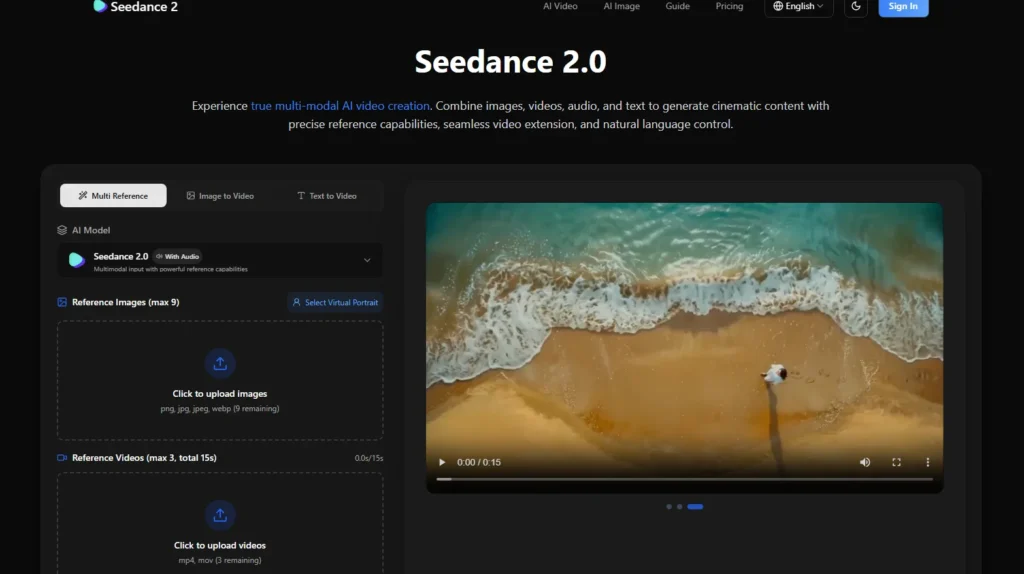
Most AI video generators process a text prompt and produce a video clip. Seedance 2.0 AI operates differently at the architecture level. The model uses a Dual-Branch Diffusion Transformer that generates video and audio simultaneously rather than treating audio as a post-production layer. A character speaking in an open field produces natural ambient diffusion. A whisper carries proximity effect. These acoustic behaviors are baked into the generation pass, not added afterward.
The practical result is that Seedance 2.0 AI removes one of the more time-consuming steps in AI video production the process of sourcing, syncing, and adjusting audio to match generated footage. For teams producing dialogue-heavy content at volume, this matters more than any individual quality benchmark.
Inputs the Model Accepts AI Video Creation Platform
Seedance 2.0 AI Video Creation Platform accepts up to 12 reference files per generation within the same workflow. The @ reference system lets users tag specific files within a prompt a reference image for character appearance, a video clip for camera movement style, an audio file for rhythm or tone matching.
Director’s Mode adds manual camera path control, allowing users to define panning, tilting, and zooming behavior rather than leaving camera logic entirely to the model. Supported inputs across a single generation include:
- Text prompts describing scene, mood, lighting, and character behavior
- Reference images for locking character appearance or visual style
- Video clips for replicating camera movement or motion choreography
- Audio files for beat matching, dialogue conditioning, or ambient tone reference
Output supports seven aspect ratios covering vertical formats for short-form platforms, widescreen for standard video, and square for social grids. Clip duration runs up to 15 seconds at full quality settings. Generation time sits at roughly 3 to 5 minutes depending on resolution and server load, though free-tier users on shared infrastructure report substantially longer waits during peak hours.
Every output carries a C2PA provenance watermark embedded in file metadata. This watermark is invisible to viewers but readable by C2PA-compliant tools, and records that the content was AI-generated, the generation timestamp, and the model used.
What the Output Looks Like
| Output Parameter | Specification |
|---|---|
| Resolution range | 480p (fast draft) to 2K (high-tier plans); 1080p standard on mid-range |
| Clip duration | Up to 15 seconds at full quality |
| Aspect ratios | 16:9, 9:16, 1:1, 4:3, 3:4, and two additional social formats |
| Generation time | 3 to 5 minutes at standard load; longer on free-tier shared servers |
| Audio output | Dialogue, ambient sound, music, and reverb generated in the same pass |
| Watermark | C2PA metadata watermark on all outputs; visible watermark removed on paid plans |
Multi-shot storytelling is built into the generation logic. The model reads a prompt, plans a shot sequence, and maintains character appearance, clothing, and lighting continuity across cuts within a single clip.
Audio coherence is the output quality that reviewers most consistently flagged as a genuine differentiator. A character speaking in a large room produces natural reverb. Beat matching aligns visual motion to an uploaded audio file’s rhythm. Lip sync accuracy in dialogue scenes holds up noticeably better than in models that layer audio onto pre-generated footage.
Two output quality limitations appear consistently in documented user tests. On-screen text rendering inside scenes produces inconsistent results across generations, affecting use cases where signs, product labels, or title cards need to be accurate. Complex scenes involving multiple interacting objects also produce physics inconsistencies that do not approach the simulation quality of Sora 2 in head-to-head tests.
Where Seedance 2.0 AI Performs Well and Where It Does Not
The model’s reputation depends heavily on how a user approaches it. Seedance 2.0 produces stronger output when the operator arrives with concrete visual references and clear directional intent. Weak prompts and no reference files leave more of the creative logic to the model, and the results reflect that.
Strong Use Cases
High-volume advertising creative is where Seedance 2.0 consistently earns positive feedback. For teams producing short-form ads at scale social cuts, product loops, regional variants the multimodal input system reduces the iteration cycle. A reference image locks character appearance. A reference video defines motion style. The text prompt handles scene and context. The result is more predictable output with fewer generations needed to reach an approved cut.
E-commerce product video is a specific strength that several reviewers noted in 2026 tests. Seedance 2.0 AI preserves product details, logos, and text across frames more reliably than some competing models, which matters when a product shot needs to remain accurate through camera movement or lighting changes.
Dialogue-heavy scenes requiring lip sync are where the unified audio-video architecture produces the clearest practical advantage. Independent tests posted on X in early 2026 showed Seedance 2.0 AI producing more coherent dialogue sequences than Runway Gen-4.5 for scenes where character speech needed to match specific audio reference tracks.
Where It Struggles
Casual users without prepared references find the learning curve steep. Reviewers on PixVerse and independent platforms consistently rate Seedance 2.0 at 8.5 out of 10 for professional users and around 5 out of 10 for casual users who want to type a sentence and receive a usable video. The @ reference system, timeline prompting, and Director’s Mode all require time to learn before they produce reliable results.
Text rendering inside video frames remains unreliable. If a scene includes a sign, a product label, or a title card rendered within the video itself, expect inconsistency across generations. This is not unique to Seedance 2.0, but it is a real limitation for specific use cases.
The model has no LoRA support. Users who need a custom visual style applied consistently a specific brand aesthetic or recurring character look cannot fine-tune the model on their own dataset. Competitors including Runway Gen-4.5 offer more flexibility for workflow customization at the pipeline level.
API access only became globally stable on April 9, 2026, when fal.ai launched official Seedance 2.0 API availability. Teams that needed programmatic access before that date dealt with rate limit surprises and breaking changes. Developer documentation is still maturing relative to older models with larger community ecosystems.
Real User Experiences With Seedance 2.0 AI
Based on feedback gathered across Reddit, X, YouTube review channels, and platform-level commentary from early 2026, the pattern of how real users encountered Seedance 2.0 AI is fairly consistent and more nuanced than the launch coverage suggested.
The most common productive use case reported by creators was short-form advertising content. Multiple users on Reddit described building workflows where a product image served as the primary reference, a competitor’s video clip provided motion style cues, and a short text prompt handled scene direction. Several reported reaching publishable output within four to six generations faster than their previous workflows using Runway or Kling 3.0, specifically because the audio came out of the generation already synced.
The outcome that surprised users most was audio quality. Users who approached Seedance 2.0 AI expecting to handle audio separately as they would with most other tools reported being caught off guard by how coherent the sound design was on first generation. Multiple YouTube reviewers in February and March 2026 noted that ambient audio, reverb behavior, and lip sync held up across different scene types without manual correction.
The recurring disappointment was access. International users without Chinese payment methods or phone numbers encountered significant friction accessing the tool at the point of peak interest the weeks immediately following the February 12 launch. Community forums and Reddit threads from that period are filled with reports of 6 to 8 hour queue times on free servers, mandatory Chinese phone number verification on some platforms, and watermarked output on all free-tier generations. Several users reported abandoning the tool during this period before the Dreamina international platform and fal.ai API access resolved part of the problem in late February and April 2026 respectively.
A second consistent complaint involved credit management. Monthly subscription credits do not roll over on standard plans. Users who had uneven production schedules heavy one month, light the next reported losing significant credit balances at billing cycle end. This specific issue appeared repeatedly in Reddit threads discussing Seedance 2.0 pricing and was a contributing factor in some users preferring Kling 3.0’s more predictable per-video pricing model.
Revised Access, Pricing, and What You Lose on the Free Tier
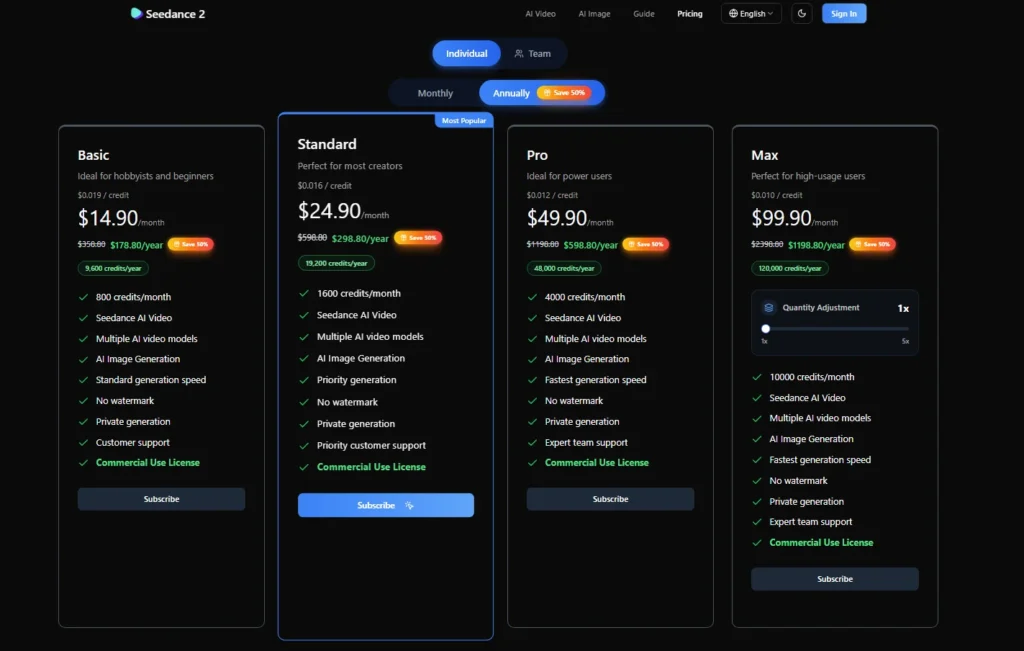
Seedance 2.0 pricing does not follow a single clean subscription model. Depending on where a user accesses the tool, the cost appears as a consumer subscription, a daily credit allowance, API pay-as-you-go billing, or a third-party wrapper with its own pricing layer.
| Access Route | Approximate Cost | Key Limitation |
|---|---|---|
| Jimeng (China) | 69 RMB/month ($9.60) | Requires Alipay or WeChat Pay; Chinese interface |
| Dreamina (International) | Free tier available; paid plans above | 225 daily tokens shared across all tools; watermarks on free output |
| fal.ai API | $0.247/sec (Pro); $0.022/sec (Fast) | Per-second billing; requires accurate length estimates to budget |
| Third-party platforms | Varies by provider | Adds cost layer above base pricing; eliminates some regional barriers |
Free-tier outputs carry watermarks. The monthly subscription removes watermarks and unlocks commercial licensing. Credits on monthly plans do not roll over when the billing cycle ends, which has been a documented complaint from users with uneven production schedules. Yearly plans and one-time credit packs do not carry the same expiration behavior, making them a better option for anyone whose output volume varies month to month.
The practical summary for international users in mid-2026 is that free access exists but comes with real friction. Queue times during peak hours have been reported at 15 to 30 minutes on Dreamina’s free tier. Watermarks appear on all free output. Commercial use requires a paid plan. For anyone evaluating Seedance 2.0 for client-facing or production work, testing on the free tier is feasible but publishing directly from it is not.
How Seedance 2.0 AI Compares to Kling, Runway, and Veo 3.1
Seedance 2.0 does not win every category in direct comparisons. The honest picture from benchmark data and user tests published in 2026 is that each major competitor holds advantages in specific areas, and the right choice depends on what a workflow actually requires.
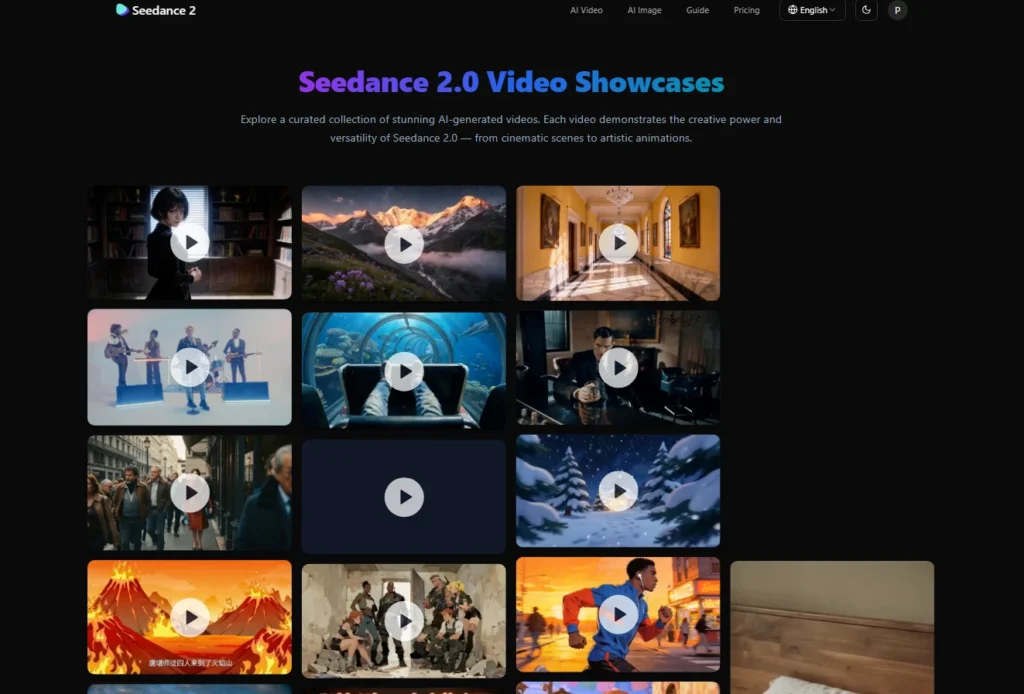
Seedance 2.0 vs Kling 3.0
Kling ai , developed by Kuaishou, produces native 4K video at up to 60 frames per second with physics simulation that multiple testers in 2026 rated higher than Seedance 2.0 AI for natural human movement and complex action sequences. For product demonstrations requiring realistic physical interaction or detailed character motion, several independent reviewers found Kling 3.0 produced fewer artifacts under the same conditions.
Seedance 2.0 holds the advantage in multimodal control and production speed. The ability to feed up to 12 reference inputs, combine audio conditioning with visual references, and receive synced audio output in a single pass gives Seedance 2.0 a workflow advantage for high-volume ad production. Kling 3.0 uses a more predictable per-video pricing structure that users with uneven production schedules consistently preferred over Seedance 2.0’s credit expiration behavior.
Seedance 2.0 vs Runway Gen-4.5
Runway Gen-4.5 ranked first on the Video Arena leaderboard in early 2026 for some evaluators and has a deeper editing suite than Seedance 2.0. Motion Brush, timeline editing, and integration with professional post-production workflows give Runway an advantage for filmmakers who need to refine output after generation rather than getting the final result in one pass.
Seedance 2.0 approaches generation differently. The model is built for operators who arrive with a defined scene and want the complete output including audio to come out of a single generation rather than building it in layers. Independent tests shared on X showed Seedance 2.0 outperforming Runway Gen-4.5 on dialogue-heavy scenes where audio reference tracks needed to match generated footage, specifically because Runway’s audio is handled as a separate step.
Seedance 2.0 vs Veo 3.1
Veo 3.1, developed by Google DeepMind, shares Seedance 2.0’s native audio-video generation architecture and competes directly at the top of the 2026 benchmark leaderboards. Benchmark data from the Artificial Analysis Video Arena leaderboard as of May 2026 shows both models trading positions depending on evaluation criteria.
Veo 3.1 holds an advantage on reference consistency across generations, which matters for projects where the same character or environment needs to appear stable across multiple clips. Seedance 2.0 holds the advantage on multimodal input depth and pricing at the entry level. Veo 3.1 starts at $0.15 per second in fast mode, which positions it above Seedance 2.0’s Jimeng and Dreamina subscription tiers for comparable usage volume, though below Sora 2’s $0.75 per second rate.
Revised: Access, Pricing, and What You Lose on the Free Tier
Seedance 2.0 pricing does not follow a single clean subscription model. Depending on where a user accesses the tool, the cost appears as a consumer subscription, a daily credit allowance, API pay-as-you-go billing, or a third-party wrapper with its own pricing layer.
| Access Route | Approximate Cost | Key Limitation |
|---|---|---|
| Jimeng (China) | 69 RMB/month (~$9.60) | Requires Alipay or WeChat Pay; Chinese interface |
| Dreamina (International) | Free tier available; paid plans above | 225 daily tokens shared across all tools; watermarks on free output |
| fal.ai API | $0.247/sec (Pro); $0.022/sec (Fast) | Per-second billing; requires accurate length estimates to budget |
| Third-party platforms | Varies by provider | Adds cost layer above base pricing; eliminates some regional barriers |
Free-tier outputs carry watermarks. The monthly subscription removes watermarks and unlocks commercial licensing. Credits on monthly plans do not roll over when the billing cycle ends, which has been a documented complaint from users with uneven production schedules. Yearly plans and one-time credit packs do not carry the same expiration behavior, making them a better option for anyone whose output volume varies month to month.
The practical summary for international users in mid-2026 is that free access exists but comes with real friction. Queue times during peak hours have been reported at 15 to 30 minutes on Dreamina’s free tier. Watermarks appear on all free output. Commercial use requires a paid plan. For anyone evaluating Seedance 2.0 for client-facing or production work, testing on the free tier is feasible but publishing directly from it is not.
Pros of Seedance 2.0
Based on recurring positive feedback from YouTube reviewers, Reddit threads, and X posts from February through April 2026:
- Native synchronized audio. Ambient sound, reverb behavior, and lip sync accuracy hold up across scene types without manual correction. Multiple YouTube reviewers in early 2026 documented this as the feature that most reduced their post-production workload.
- Multimodal reference depth. Accepting up to 12 simultaneous reference files gives users output control that produces more predictable results across large content batches. Reddit users working in ad production cited this as the primary reason they stayed with Seedance 2.0 after the initial access frustrations.
- Multi-shot storytelling. Character identity and lighting continuity hold across shot cuts within a single clip, reducing the number of separate generations needed to build a coherent sequence.
- Generation speed. Standard quality 1080p outputs come through within 3 to 5 minutes under normal server load, which is 20 to 40 percent faster than Seedance 1.5 according to documented platform notes confirmed by users on X.
Cons of Seedance 2.0
Based on recurring complaints from Reddit, community forums, and platform reviewers from February through April 2026:
- International access barriers: Chinese phone number requirements on some platforms, payment method restrictions on Jimeng, and watermarks on all free-tier output created a poor first experience for international users. The fal.ai API launch in April resolved the developer access problem, but consumer-facing access outside China still requires navigating multiple platform options.
- Credit expiration on monthly plans: Unused credits disappear at the end of the billing cycle on standard plans. Several Reddit threads from March and April 2026 named this behavior as a direct reason to choose Kling 3.0 instead, where per-video pricing means unused capacity does not disappear.
- Steep learning curve for casual users: The @ reference system, Director’s Mode, and timeline prompting all require deliberate practice before producing reliable output. Reviewers on PixVerse and independent platforms scored Seedance 2.0 at around 5 out of 10 for casual users versus 8.5 out of 10 for professional operators.
- Aggressive content moderation: Following the February 2026 copyright disputes, ByteDance tightened safeguards in ways that caused legitimate creative prompts involving realistic human subjects to be rejected. Moderation updates in April 2026 lifted some restrictions, but the behavior remains less predictable than on older, more established models.
- No LoRA support: Users cannot fine-tune the model on custom datasets. Brands or studios needing a consistent proprietary visual style across all generations cannot achieve that within Seedance 2.0. Runway Gen-4.5 offers more pipeline-level customization for teams with that requirement.
What Makes Seedance 2.0 Different
The structural differentiator in mid-2026 is the combination of multimodal input depth and native joint audio-video generation in a single pass. No directly competing model at a comparable price point accepts up to 12 reference files simultaneously while also producing synced audio as part of the same generation.
| Competitor | Stronger Than Seedance 2.0 At | Weaker Than Seedance 2.0 At |
|---|---|---|
| Kling 3.0 | Raw 4K visual quality; natural human motion; per-video pricing predictability | Multimodal input depth; native audio generation |
| Runway Gen-4.5 | Post-generation editing suite; timeline control; pipeline customization | Single-pass audio-visual output; reference volume per generation |
| Veo 3.1 | Reference consistency across multiple clips | Entry-level pricing; multimodal input count |
| Sora 2 | Physics simulation; long-form clip quality | Cost; access; audio-visual integration in one pass |
For users who do not need the multimodal plus native audio combination, Seedance 2.0 is a strong but not uniquely superior option. The honest assessment from documented 2026 comparisons is that it earns its position in the top tier without cleanly dominating it.
Is Seedance 2.0 free to use?
Seedance 2.0 offers a limited free tier through Dreamina, ByteDance’s international platform, which provides 225 daily tokens shared across all tools on the platform. That allocation supports roughly one to two short video generations per day. Free-tier outputs carry watermarks and cannot be used commercially. International users on some platforms also face Chinese phone number verification requirements that block access entirely. For anything beyond basic testing, a paid subscription or API access through fal.ai is the practical route.
How does Seedance 2.0 compare to Kling 3.0 for video quality?
Kling 3.0 produces native 4K video at up to 60 frames per second with physics simulation that independent testers in 2026 rated higher for natural human movement and complex action sequences. Seedance 2.0 holds the advantage in multimodal input control and native synchronized audio generation. For product demonstrations and realistic motion, Kling 3.0 generally delivers stronger visual output. For high-volume ad production where audio sync and reference-driven consistency matter more than raw resolution, Seedance 2.0 has the workflow edge.
What is Seedance 2.0 best suited for?
Seedance 2.0 performs best in professional workflows where the user arrives with concrete visual references, a defined scene structure, and a need for synchronized audio output without separate post-production steps. High-volume advertising creative, short-form brand video, dialogue-heavy scenes, and e-commerce product video are the use cases where documented user results have been most consistently positive. Casual users who want to type a prompt and receive a polished video without technical setup will find the tool harder to use than Pika Labs or the simpler tiers of Runway.
Why did Seedance 2.0 face legal complaints after launch?
Within one day of the February 12, 2026 release, viral clips featuring Hollywood actors and licensed intellectual property flooded social media. Disney sent a cease-and-desist letter on February 13. The Motion Picture Association condemned the model for large-scale unauthorized use of copyrighted film and television content. Paramount Skydance, SAG-AFTRA, and the Copyright Alliance also issued formal statements. ByteDance responded on February 16 with a pledge to strengthen content safeguards, and moderation has since been tightened. The official API release through fal.ai in April 2026 came after months of access uncertainty partly tied to these disputes.
How much does Seedance 2.0 cost per month?
The cheapest official access is through ByteDance’s Jimeng platform in China at approximately 69 RMB per month, which is roughly $9.60 at current exchange rates, but it requires Chinese payment methods. International users on Dreamina pay more for equivalent access. API pricing through fal.ai runs at $0.247 per second for the Pro model and $0.022 per second for the Fast model. Monthly subscription credits do not roll over at the end of the billing cycle on standard plans, which has been a recurring complaint from users with uneven production schedules. Yearly plans and one-time credit packs do not carry the same expiration behavior.
Write a Review

Similar AI Tools

Kling AI Review 2026 – What It Actually Delivers for Video Creators

Recraft AI Review The Free SVG Converter , logo generator and Image Generator

Nano Banana AI – Best AI Image Generator
