

Poe AI: The All-in-One AI Toolkit That Puts Every Major Model in One Place
If you work with AI tools regularly, you know what this looks like: one browser tab for ChatGPT, another for Claude, a third for Gemini, maybe a fourth for an image generator. Each one needs its own account, its own login, its own subscription. Switching between them mid-task breaks your flow, and comparing their outputs means copying and pasting across four different windows.
Poe AI was built to fix exactly that. Rather than creating its own AI model, Poe acts as a single platform that gives you access to the most powerful AI models in the world, ChatGPT, Claude, Gemini, Llama, DeepSeek, and many more, all through one interface, one account, and potentially one subscription. Think of it the way you’d think of a universal remote: the TVs and devices are all still made by different companies, but you control all of them from one place.
What Is Poe AI?
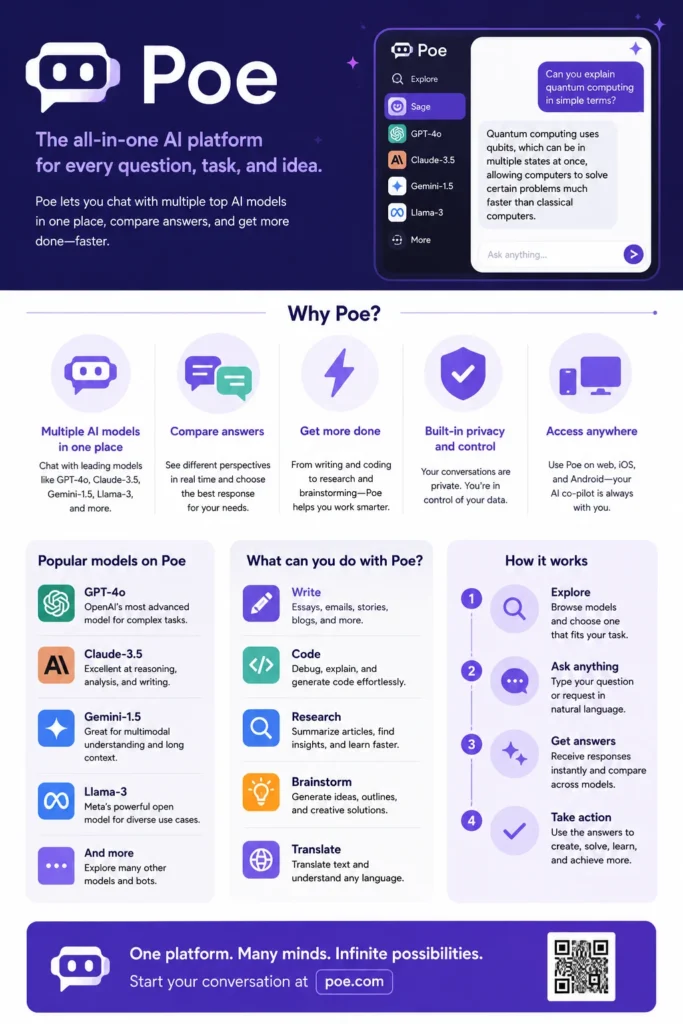
Poe AI stands for Platform for Open Exploration. It is an AI chatbot aggregator developed by Quora, first launched in December 2022 and made publicly available in early 2023.
If you know Quora, you know it as the question-and-answer website where experts share knowledge on almost every topic. Poe is Quora’s bet on where AI is heading: instead of one dominant model winning everything, users will want to move fluidly between different AI tools depending on the task.
The name “Poe” is a nod to Edgar Allan Poe, the American writer. That is fitting, since one of the platform’s most popular uses is creative writing and storytelling.
By the numbers:
| Metric | Figure |
|---|---|
| Monthly visitors (Sept 2024) | 31.5 million |
| Funding raised (Jan 2024) | $75 million (Andreessen Horowitz) |
| Custom bots on platform | Over 1 million |
| AI models available | Over 100 |
| Monthly visits (Aug 2025) | 15.5 million |
That is not a scrappy side project. It is a well-funded platform with serious backing and a growing user base.
What Models Does Poe AI Give You Access To?
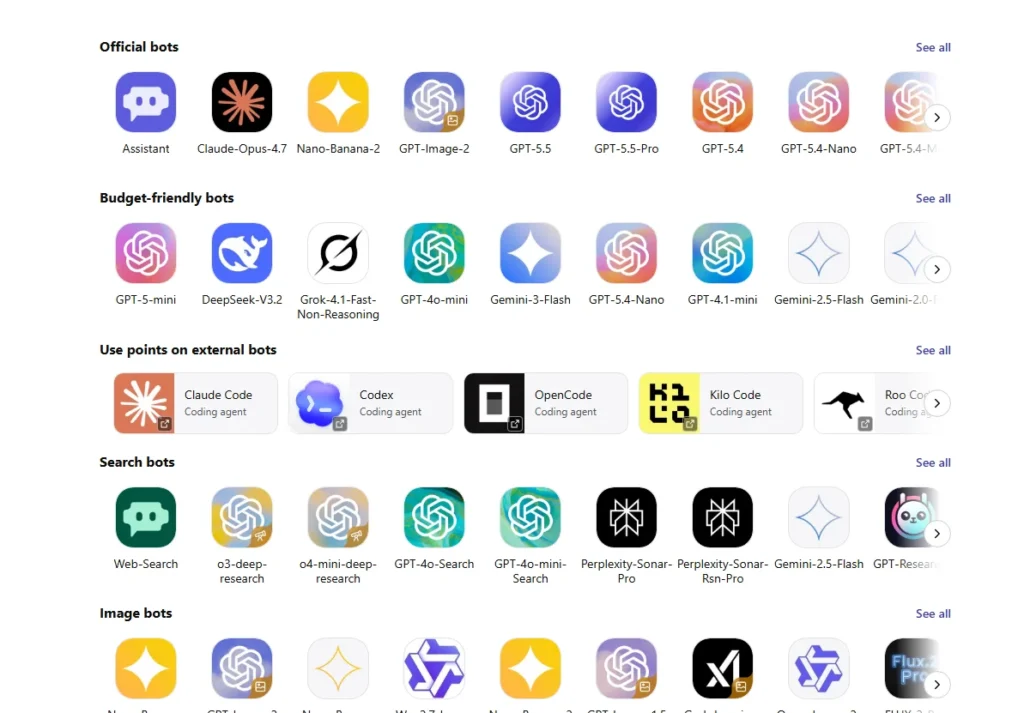
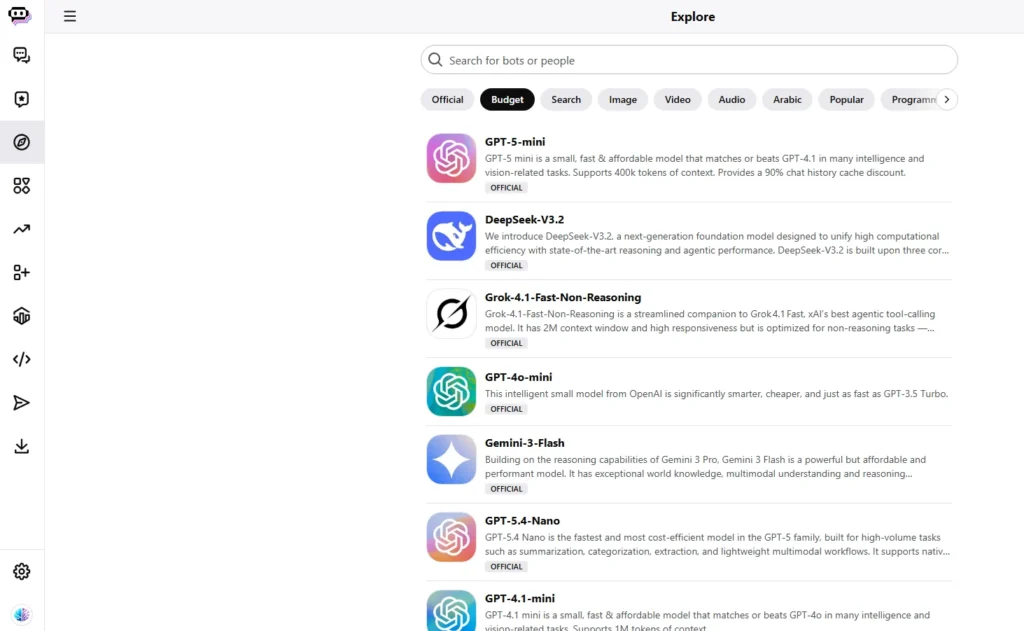
This is where Poe’s real value becomes concrete. Rather than listing all 100+ models, here is what matters most to most users:
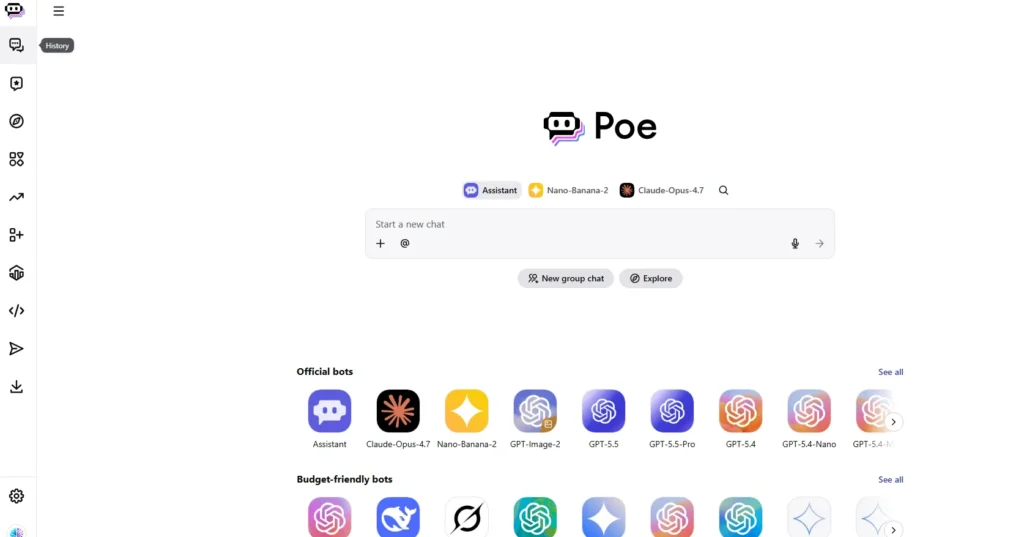
Text and Reasoning Models
| Model | Best Used For |
|---|---|
| GPT-4.1 / GPT-5 (OpenAI) | Structured output, coding, consistent drafts |
| Claude Opus 4 (Anthropic) | Long-form writing, nuanced reasoning, long contexts |
| Gemini 3.5 (Google) | Real-time information, Google-integrated tasks |
| Llama 4 (Meta) | Open-source tasks, research experimentation |
| DeepSeek | Technical and scientific reasoning |
Image Generation Models
| Model | Style |
|---|---|
| Stable Diffusion XL | Highly customizable, photorealistic |
| Ideogram 2.0 | Text-in-image, graphic design |
| FLUX 1.1 | High detail, artistic output |
| DALL-E 3 (via GPT) | General purpose, accessible |
Video and Audio Models
- Veo 2 (Google): Video generation
- Runway / Dream Machine: Video editing and creation
- ElevenLabs Multilingual v2: Realistic voice generation
- Imagen 3: High-quality image synthesis
Web-Connected Bots
Some bots on Poe can access the internet in real time, helping them deliver up-to-date information beyond their base training data. This is useful for research, fact-checking, and news-related tasks.
Why this matters in practice: A writer can draft an article with Claude, generate a header image with Stable Diffusion XL, then use a web-search bot to fact-check statistics, all without leaving Poe. That workflow would normally require four separate tools and accounts.
Key Features What Poe Actually Does
Multi-Bot Conversations
Users can switch between different bots within the same conversation or run separate threads with different models, allowing for real-time response comparisons and a more flexible experience.
In practice, this means you can ask the same question to Claude and ChatGPT at the same time and compare their answers side by side. This is genuinely useful when the quality of an answer matters, for research, legal questions, or technical writing where you want a second opinion from a different model.
Custom Bot Creation (No Coding Required)
Poe allows users to build their own bots in two ways. Prompt bots use simple instructions on top of existing models and do not require coding. Server bots are more advanced and can connect with external systems using custom backend logic.
What this means for a non-technical user: you can build a custom assistant, say, a bot that always responds in a specific tone, focuses only on a particular topic, or acts as a specialized writing coach, by writing a plain-English description of what you want. No code. No API keys. Just a text description, a model selection, and you’re done.
For developers, the server bot option lets you connect Poe’s interface to your own backend, enabling more sophisticated, data-connected AI tools.
Creator Monetization
This feature sets Poe apart from almost every other AI platform. The platform implemented a creator monetization system in April 2024. Bot creators earn revenue through two methods: subscription revenue sharing when users upgrade because of their bots, and a price-per-message model where creators set specific costs per interaction.
Over $100,000 had been paid out to bot makers by mid-2026. That’s a real, if still modest , ecosystem for creators who build genuinely useful tools.
Cross-Platform Access
Poe is accessible on the web, on desktop apps for Windows and macOS, and on mobile apps for iOS and Android, with all your chats synced across devices automatically.
This matters more than it sounds. If you start a research thread on your laptop and need to reference it on your phone during a meeting, everything is there. No re-logging in, no lost conversations.
Poe AI Pricing: Plans Breakdown 2026
Poe operates on a freemium model. Here is an honest look at each tier:
| Plan | Price | Daily Points | Best For |
|---|---|---|---|
| Free | $0 | 300 points/day | Casual testing, light use |
| Starter | $5/month | 10,000 points/day | Light professional use |
| Standard | $19.99/month | ~1 million points/month | Regular users replacing 2+ subscriptions |
| Power | $249.99/month | 12.5 million points/month | Teams, agencies, high-volume workflows |
| Pay-as-you-go | Variable | Add-on credits | Occasional heavy tasks |
Free Plan
The free version offers 300 points daily to ask questions and get answers, but doesn’t give access to exclusive bots like o1, o3-mini-high, and others. For casual use, testing the platform, occasional questions, trying out different models, the free plan works. For anything resembling a daily workflow, you’ll hit its limits quickly.
$5/Month Plan (New in 2025)
Poe introduced the $5/month tier in March 2025, specifically to align with the trend that standard AI models are getting cheaper while the most advanced models are becoming more expensive. This plan gives you 10,000 points per day , noticeably more than the free tier, though still not unlimited. It’s a reasonable entry point for light professional use.
$19.99/Month Plan
This is the main subscription most users will evaluate. It provides access to advanced models including ChatGPT, Claude, and Gemini, with higher daily limits and an ad-free experience. This pricing is competitive with standalone subscriptions like ChatGPT Plus, and it replaces the need for multiple separate subscriptions , which is its core value proposition.
$249.99/Month Power Plan
The higher-tier plan at $249.99/month provides 12.5 million points per month, intended for power users who need to send large volumes of messages to expensive models like o1-pro, GPT-5, and Veo 2. This tier is clearly not for individuals, it’s aimed at teams, agencies, or developers running high-volume workflows.
Pay-As-You-Go Credits
Anyone with a Poe subscription can purchase additional credits whenever needed. This is useful if you occasionally need to run heavy tasks without committing to a higher monthly plan.
Is Poe Cheaper Than Subscribing Directly?
Here’s a concrete comparison worth knowing: models from Anthropic, Google, and OpenAI currently cost 10–30% less on Poe compared to accessing them through their standard rates, with no hidden fees. For users who regularly use two or more of these models, a single Poe subscription can replace multiple separate subscriptions at a lower combined cost.
The catch, and this is a real one worth flagging, is that Poe’s point-based system makes it harder to predict exactly how much usage you’re getting for your money compared to a simple “unlimited” plan. Heavy users of specific premium models like Claude Opus or ChatGPT can burn through points faster than they expect.
Who Should Use Poe AI?
Poe isn’t a tool for everyone, and it’s worth being specific about who actually benefits from it versus who would be better served by going directly to a single model.
Students and Researchers
If you’re writing a paper, preparing for an exam, or trying to understand a complex topic from multiple angles, Poe’s multi-model access is directly useful. You can ask the same question to three different models and compare how they explain it. Claude tends to give more nuanced, structured answers on complex topics. ChatGPT often excels at concrete examples. Gemini can pull in more current information through its web-connected version. Having all three available without switching accounts saves real time.
Content Creators and Writers
Writers who produce a high volume of content, blog posts, scripts, social media copy, newsletters, benefit from being able to test different models against the same brief and pick the best output. ChatGPT often produces longer, more consistent drafts, while Poe helps find different creative voices fast by letting you sample Claude, ChatGPT and others in the same session. If you also generate images for your content, having Stable Diffusion XL and Ideogram bundled in saves an additional subscription.
Small Business Owners and Marketing Teams
Marketing agencies can draft ads, client proposals, and campaign briefs faster, while small businesses can automate FAQ responses, social content, and customer communication. The custom bot feature is particularly practical here, you can build a bot that already knows your brand voice, your product names, and your tone guidelines, and use it consistently across your team without each person having to re-prompt from scratch every time.
Developers and Prototypers
If you’re building a product and want to test how different models handle the same task before committing to one API, Poe is a fast way to run those comparisons without setting up separate integrations. A common approach teams use is to prototype on Poe, then move to ChatGPT or another model’s native API for production. Poe also now supports tool calling through its API, which means it can be used directly in agentic workflows, not just for manual testing.
AI Enthusiasts Who Want to Explore
Poe is designed for users of all experience levels who are interested in exploring AI. If you’re someone who genuinely enjoys seeing how different models approach the same problem, or you want to stay current with new model releases without managing multiple accounts, Poe’s breadth makes it a natural home base. When a new model is made available by an AI company, it’s typically added to Poe quickly, often on the same day it’s released.
Who Poe Is Not For
If your work revolves around a single specific model — say, you use Claude exclusively for long-context document analysis, or you rely on GPT’s code interpreter for data work going directly to that provider’s native app usually gives you a cleaner, more capable experience. Poe’s interface is optimized for breadth, not depth. It also isn’t suitable if your organization handles regulated data, since your prompts are routed through third-party infrastructure before reaching the model.
How Poe Compares to the Alternatives
Poe AI vs. ChatGPT
This is the comparison most people want answered, and the honest answer is that they’re built for different things.
ChatGPT gives you the deepest possible access to OpenAI’s own models. That means the code interpreter, file uploads, image editing through DALL-E, and for enterprise users data controls and compliance features that Poe doesn’t offer. Developers and startups usually find ChatGPT wins on stronger APIs, enterprise features, and production readiness.
Poe wins on model variety. If your work requires switching between Claude for writing, ChatGPT for reasoning, and Gemini for research in the same day, a single Poe subscription replaces three separate ones. ChatGPT has around 700 million weekly users and focuses on a single AI system, while Poe aggregates multiple models including ChatGPT, Claude, and Gemini in one interface. That difference in approach defines which one fits your workflow.
The practical summary: if you use one AI model for focused, professional work, ChatGPT (or Claude directly) is probably cleaner. If you regularly need more than one model, Poe is more economical and more flexible.
Poe AI vs. Claude (Directly)
Claude, accessed directly through Anthropic’s own app or API, gives you the full Claude experience extended context windows, cleaner privacy controls, and Anthropic’s native interface. If Claude is your primary tool and you use it for long, complex documents or sensitive work, going directly to Anthropic is the smarter choice.
If Claude is your primary need, going direct may offer cleaner pricing and limits. Poe adds broader model selection on top. So Poe makes sense here only if you want Claude plus other models not if Claude alone does what you need.
Poe AI vs. Perplexity
Perplexity is built specifically for AI-powered search real-time, cited answers pulled from the web. It’s exceptional at that one thing. Poe doesn’t try to compete with it there. Perplexity is exceptional for AI-first search and cited answers; it’s less focused on bot marketplaces. Poe is stronger for model variety and bot creation.
If research and fact-checking with sources is your core use case, Perplexity is the better tool. If you want to do research, writing, image generation, and experimentation all from one place, Poe’s breadth wins.
Real Limitations What to Know Before You Subscribe
Every review of Poe mentions its strengths. Here are the limitations that could genuinely affect your decision:
Daily message caps apply even on paid plans.
Even on paid plans, popular models like GPT-5 and Claude have daily message limits, which can be restrictive for heavy users. This is the most common complaint from Poe’s paying subscribers. If you’re running intensive workflows dozens of long prompts per day you can exhaust your point allowance before the day ends. The $19.99/month plan is not unlimited in any practical sense for heavy GPT-5 or Claude Opus usage.
Your data travels through third-party systems.
Since prompts are routed to third parties, your data is governed by external privacy policies which may not suit sensitive or enterprise-level use cases. When you use Claude on Poe, your prompt goes to Poe’s servers first, then to Anthropic’s.
That’s one additional layer your data passes through compared to using Claude directly. For general use, this is fine. For anything involving client data, financial records, or health information, review the policies of both Poe and the underlying model provider carefully.
The bot marketplace quality is uneven.
Community quality is uneven not all public bots are well-designed, and you should expect some trial and error. With over a million user-created bots on the platform, the range in quality is enormous. Some are well-crafted and genuinely useful. Many are rough drafts that haven’t been updated or tested. There’s no reliable quality signal beyond usage counts, so finding good community bots takes more patience than the marketplace’s scale might suggest.
NSFW filters occasionally block harmless content.
Poe’s NSFW filters can sometimes be overly aggressive. If you write fiction, dark satire, or content that touches on mature themes without being explicit, you may find Poe’s moderation interrupts you in ways that feel unnecessary. This is a platform-level filter applied on top of whatever the underlying model would normally permit.
Advanced bot customization requires technical skills.
Prompt bots are genuinely accessible to anyone. But if you want a bot that connects to external data, pulls from your own database, or behaves in complex ways based on user input, server bots require coding skills and backend infrastructure. Poe markets bot creation as no-code, and it is up to a point. Beyond basic customization, the ceiling arrives quickly for non-developers.
No offline access.
Poe requires an internet connection for everything. There’s no local model option, no cached mode, and no offline access to previous conversations without connectivity. For most users this is a non-issue, but it’s worth noting if you work in environments with unreliable internet.
Is Poe AI Worth It? The Honest Verdict
Poe earns its place in a workflow when it replaces multiple separate subscriptions rather than sitting alongside them. If you’re currently paying for ChatGPT Plus and considering adding Claude or Gemini, the math tilts toward Poe: one $19.99/month subscription versus two or three at $20/month each, with the added convenience of not switching between apps.
Poe is a polished, powerful AI hub that centralizes top models with strong bot-building tools and a lively community of user-made assistants. The interface is genuinely clean, onboarding takes minutes, and the cross-device sync works reliably. For someone who wants to explore the landscape of AI tools without managing five different accounts, it’s one of the most practical options available in 2026.
Where it falls short is in depth. If you need the full power of any single model — GPT-5’s code interpreter, Claude’s extended context window at its maximum, or Gemini’s deep Google integrations — the native app for that model will outperform Poe. Poe is wide; it is not always deep.
The $5/month entry tier introduced in 2026 makes it reasonable to try before committing. Start there, test it against your actual workflow for a month, and upgrade if the point limits become your main frustration. That’s a more honest way to evaluate it than deciding based on a feature list alone.
Final Word
Poe AI is the most practical answer to a real problem: AI tool fragmentation. It doesn’t build the best model, it builds the best access layer to the models that already exist. For users who find themselves bouncing between ChatGPT, Claude, and Gemini daily, or who want to experiment with image and video generation without adding more subscriptions, Poe consolidates that into one place at a price that’s defensible.
It won’t replace a specialist tool for deep, focused work. But as an everyday AI toolkit, the one you open first — it makes a strong case for itself in 2026.
Poe is free for most basic usage, with subscription plans starting at $4.99/month for advanced access. The free plan gives you daily usage across a selection of models, but premium models like GPT-5 and Claude Opus are paywalled or heavily point-limited on the free tier.
For general use, yes. Poe forwards your prompts over encrypted connections to third-party models, and while Poe does log conversations and metadata for platform improvement, this aligns with common industry practices for AI services. The important caveat: if you handle regulated, sensitive, or confidential data, read both Poe’s privacy policy and the underlying model provider’s terms before using it for that work.
Yes, through the creator monetization program. Bot creators earn through subscription revenue sharing when users upgrade because of their bots, and through a price-per-message model where they set specific interaction costs. Poe provides an analytics dashboard to track earnings and usage patterns. The earning potential depends entirely on how useful and discoverable your bot is — it’s not passive income by default, and most bots earn very little. The creators who earn meaningfully are building specialized tools with real demand.
Choose Poe if you regularly need more than one AI model and want to manage them from a single place. Choose ChatGPT if you work primarily within OpenAI’s ecosystem and need its native tools — code interpreter, file analysis, enterprise compliance features. The two aren’t direct competitors so much as tools designed for different patterns of use.
Poe works across the web, desktop, and mobile, with all your chats synced across devices. The iOS and Android apps are well-rated and mirror the desktop experience closely.
Similar AI Tools

DeepSeek Ai The Free AI That Actually Competes With GPT-5

Claude AI – Coding, Content Creation & Data Analysis Compared.

Google Gemini AI Review Is It the Smartest AI Assistant for 2026?
